For expert advice  call 01832 770883

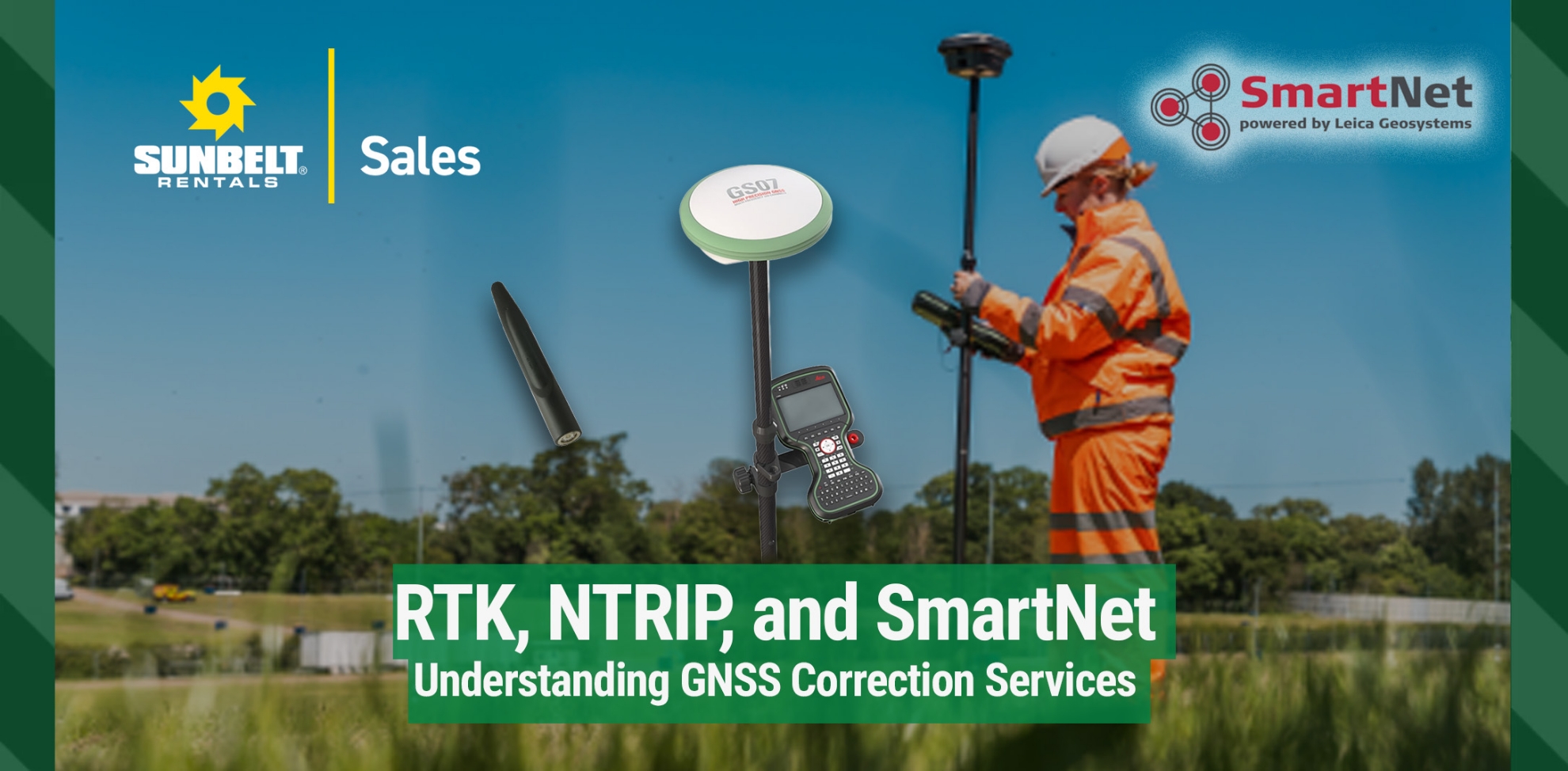
Understand how GNSS correction services improve survey accuracy; learn the difference between RTK, NTRIP, and SmartNet, how each method works, and how to choose the right setup for your sites. Includes practical troubleshooting tips and guidance on reconditioned options.
GNSS corrections feel complicated until you separate three things that often get mixed together: the positioning method, the correction source, and the delivery method. Once those are clear, the decision usually stops being “which acronym do I buy” and becomes “which workflow will hold up on site”.
If you want to talk this through with someone who handles GNSS setups daily, Sunbelt can help you match a correction method to your receiver, sites, and accuracy requirements.
Start with the GNSS Systems category or jump straight to SmartNet corrections.
A GNSS receiver determines its position by analysing satellite signals. These signals include errors such as satellite clock and orbit uncertainties, atmospheric delays, and local effects like multipath (signal reflections) and blocked sky views.
A correction service reduces the predictable part of these errors by using reference stations at known coordinates. The rover applies correction data in real time; if you are using RTK, it can achieve centimetre-level accuracy when conditions and configuration allow.
Corrections enhance what your receiver can already measure; however, they do not compensate for a poor antenna position, heavy multipath, or a location with almost no usable sky.
RTK (Real-Time Kinematic) is the method that gets you into the centimetre-accuracy tier by using carrier-phase measurements and a reference station or network.
You can source RTK corrections from:
NTRIP is how correction streams are commonly delivered over the internet. It is not the same thing as RTK; it is often how RTK corrections arrive when you are not using radio.
If your team says “we use NTRIP”, they usually mean “we receive corrections over mobile internet”; the accuracy tier still depends on whether those corrections support RTK.
You run your own base on a known coordinate; you send corrections to the rover via UHF radio or the internet.
This usually fits when:
If you need hardware that supports this workflow, start in GNSS Systems and ensure your kit and controller support base and rover configuration cleanly.
A provider runs a network of reference stations; the network models errors across an area and provides a correction stream suited to your rover’s position.
This usually fits when:
Sunbelt’s SmartNet pages sit in this world: SmartNet on Sunbelt.
With NTRIP, your rover or controller logs into a correction service using credentials, selects a stream (often called a mountpoint), and receives corrections continuously over mobile data.
Most “NTRIP problems” are not NTRIP problems; they are usually:
If you want help diagnosing this quickly, the most useful inputs are your receiver model, controller software, and what the status screen shows when it tries to fix.
SmartNet is a managed network RTK correction service; it is designed to provide a consistent corrections workflow without the need to purchase, set up, and maintain a base on every job.
On Sunbelt, you can see the productised options here:
SmartNet tends to suit teams who:
SmartNet tends to struggle when:
In those cases, the answer is often either a base workflow, better site practice (antenna height, placement, observation strategy), or a deliberate fallback plan rather than a different subscription.
Correction services and receiver capability really go hand in hand. If you're aiming for dependable RTK performance but find your current equipment is aging, not compatible with the correction stream you need, or missing essential features like multi-constellation, multi-frequency, or modern RTCM support, it could lead to spending money on subscriptions without resolving the field issues. Remember, upgrading your gear can make a big difference!
A reconditioned receiver can be a sensible move when:
The key is fit, not bargain hunting. A reconditioned kit is only “cheaper” if it supports the workflow you actually need, including your preferred correction route (single base, network RTK, NTRIP), and plays nicely with your controller and site conditions.
Sunbelt keeps Reconditioned GNSS/GPS equipment in stock.
If you are weighing new vs reconditioned, the fastest way to avoid a false economy is to sanity-check a short list.
By answering questions such as:
That is usually enough to decide whether reconditioned equipment is a smart step or a compromise that will cost you time on site.
If a rover refuses to hold a fixed solution, check these before swapping hardware.
Check that:
If you want to improve the physical side of the setup, accessories often matter more than people expect; poles, mounts, cables, antennas, and spares. Sunbelt’s GNSS Accessories category is the quickest starting point.
GNSS is a broad term that covers various satellite navigation systems. For example, GPS is just one of the GNSS constellations; however, people often use “GPS” as a quick shorthand even when referring to multiple-constellation GNSS.
If you're shopping for equipment, consider searching for ‘survey GPS’ as “GNSS systems’ instead. Begin your search at GNSS Systems, then refine your options based on your specific workflow and environment to find the best match.
A reference station or network measures current GNSS errors relative to a known coordinate and sends correction data to the rover; the rover applies that data to reduce GNSS errors in real time. With RTK, this can reach centimetre-level positioning when conditions support it.
A correction service is the source and delivery of correction data that improves accuracy, either from your own base station or from a provider network, delivered via radio or the internet.
People usually mean the four major global navigation satellite systems: GPS (US), GLONASS (Russia), Galileo (EU), and BeiDou (China). In practice, many receivers use several at once.
They ingest correction messages and apply them to their measurements. RTK-capable receivers also resolve carrier-phase ambiguities, which enables centimetre-level results.
GPS is one constellation; GNSS is the umbrella category that includes GPS and other constellations. Most modern survey receivers are GNSS, even when people say “GPS”.
Global
Navigation
Satellite
System.
Most modern smartphones support multiple constellations; people still call it GPS because it is the familiar label. Phone performance does not map neatly to surveying performance due to antenna size and signal conditions.
No single country owns “GNSS”; it is a generic term. Individual constellations are operated by different countries or blocs.